From Concept to Prototype: Best Practices in Product Development


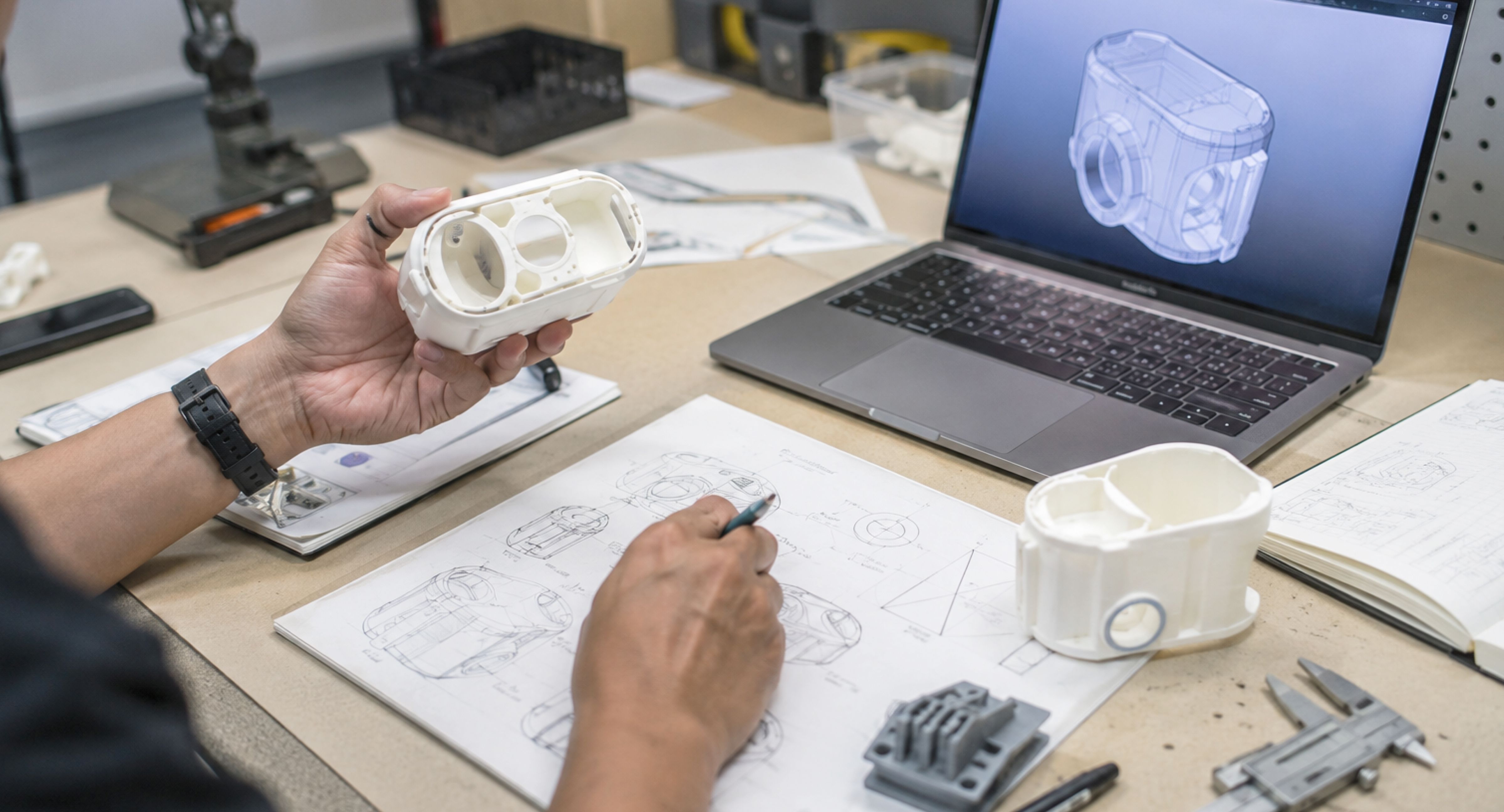
Every successful product starts as an idea, but ideas alone do not survive contact with real users, real materials, or real manufacturing lines. The gap between a sketch and a shippable product closes through disciplined product development, and prototyping is the bridge that gets you there. Here is how that journey unfolds from first concept to production-ready design.
Why Prototyping Is Critical in Product Development
A prototype turns assumptions into evidence. Concept sketches communicate an idea, but they cannot tell you whether a part will fit, a mechanism will move correctly, or a user will actually want to hold the product in their hand. Prototyping surfaces these problems early, when changes are cheap, instead of after tooling is cut and production has begun.
Skipping this stage is one of the most expensive mistakes a team can make. A flaw caught in a foam mock-up costs a redesign; the same flaw caught after manufacturing costs a recall. We treat prototyping as risk management as much as design validation.
Moving from Concept Sketches to Functional Prototypes
Concept design begins with rough sketches, mood boards, and rapid low-fidelity models that establish form, scale, and basic function. From there, the team builds toward increasingly functional prototypes: first a proof-of-concept that tests one core mechanism, then a working prototype that combines multiple systems, and finally a pre-production unit built to near-final specifications.
Each stage answers a different question. Early prototypes ask, "Does this work at all?" Later prototypes ask, "Does this work the way a customer will actually experience it?" Treating these as distinct milestones, rather than rushing straight to a polished model, keeps the process focused and the budget under control.
Design Refinement and 3D Modeling
Once a concept proves viable, engineering design takes over. 3D modeling software lets teams refine geometry, check tolerances, and simulate stress, airflow, or thermal performance before a single physical part exists. This digital stage catches interference issues, weak points, and assembly conflicts that are far harder to spot in a physical model.
3D models also become the shared language between designers, engineers, and manufacturers. A well-built CAD file shortens the feedback loop, reduces miscommunication, and feeds directly into the tooling and simulation work that follows.
Material Selection for Fiberglass, Plastics, or Composites
Material choice shapes cost, durability, weight, and manufacturability all at once, so it deserves early attention rather than a late-stage decision. Fiberglass offers strength and heat resistance for demanding structural parts - plastics like ABS or polycarbonate suit high-volume production and complex geometries at a lower cost. Composites combine multiple materials to hit specific strength-to-weight targets that a single material cannot achieve alone.
The right choice depends on the product's mechanical loads, environmental exposure, expected production volume, and target price point. We evaluate these trade-offs against the manufacturing process the product will ultimately use, since a material that is easy to prototype is not always easy to mass-produce.
Testing, Iteration, and Preparing for Production
No prototype is finished after one build. Functional testing, user feedback, and durability checks each reveal issues that feed the next iteration. This cycle repeats until the design meets performance targets and manufacturing constraints simultaneously.
The final stage translates the validated prototype into production-ready documentation: finalized tolerances, approved materials, assembly instructions, and a manufacturing process built for repeatability at scale. A prototype that performs well on a bench but ignores production realities will still stall on the factory floor, so this handoff deserves the same rigor as the design work that preceded it.
Key Takeaways
- Prototyping validates assumptions early, when design changes are still inexpensive.
- Concept sketches evolve through proof-of-concept, working, and pre-production stages.
- 3D modeling refines geometry and catches design flaws before physical builds.
- Material selection should weigh mechanical needs against production volume and cost.
- Iterative testing bridges the gap between a working prototype and a manufacturable product.
Ready to Move Your Concept Forward?
Our team partners with product teams at every stage of this process, from first sketch to production-ready prototype. Contact Us to talk through your next product development challenge.
 Message Us
 Repair
 Message Us
 Repair