Designing Injection Urethane Parts for Industrial Products


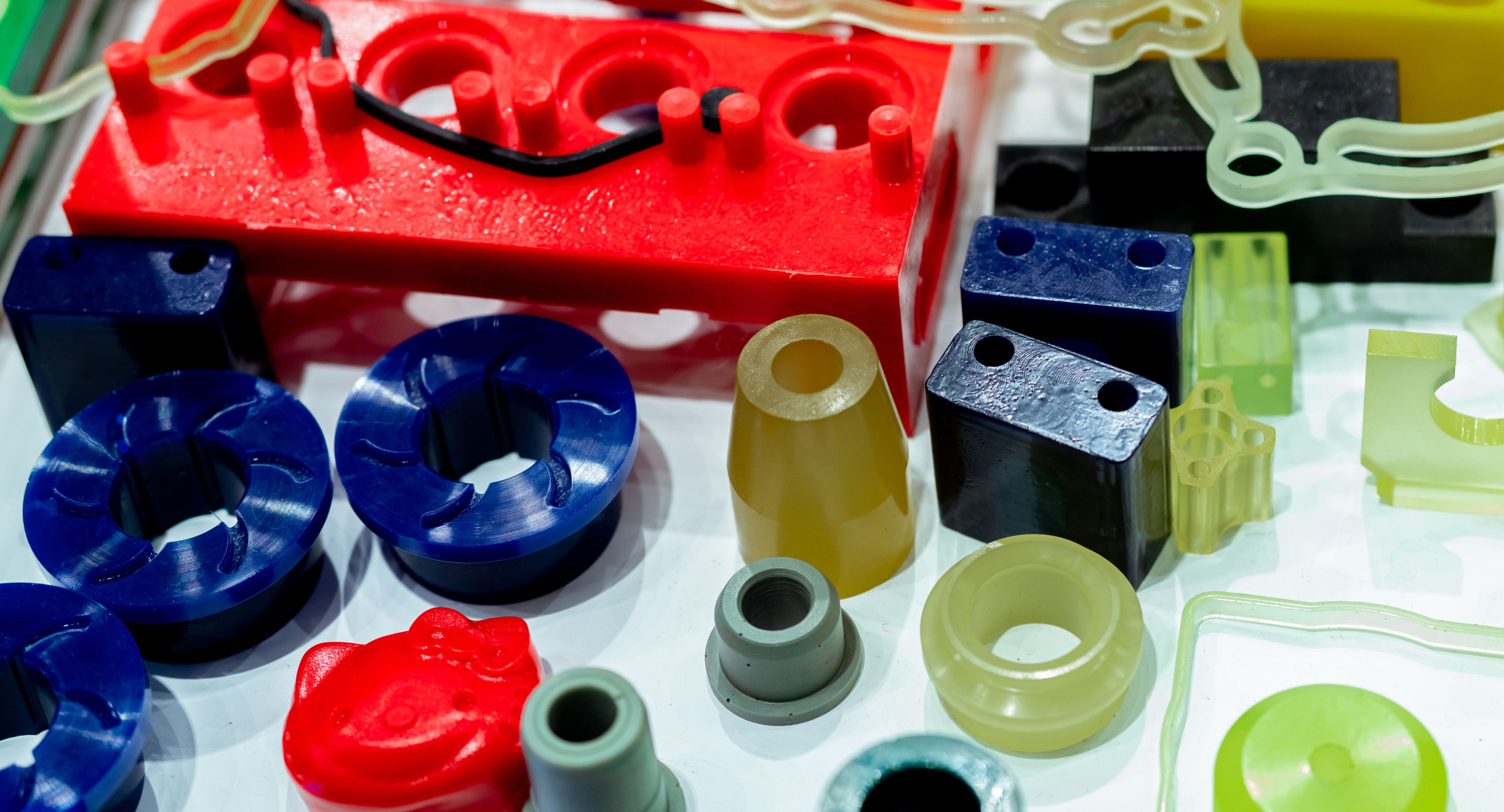
When a component needs to absorb impact, resist chemicals, and hold tight tolerances across years of heavy use, injection urethane is often the material of choice. Engineers designing industrial urethane parts must understand the process, material behavior, and design rules that separate a successful part from an expensive failure. This guide walks through the fundamentals — from how urethane molding works to the design decisions that determine whether a part performs in the field.
What Is Injection Urethane Molding?
Injection urethane molding is a manufacturing process in which liquid polyurethane components — a polyol and an isocyanate — are mixed and injected into a closed mold, where they react and cure into a solid elastomeric or rigid part. Unlike traditional thermoplastic injection molding, which relies on heat and pressure to melt and form plastic pellets, urethane molding is a reactive process: the chemistry happens inside the mold itself.
This distinguishes urethane molding from rotocasting, another liquid-casting method in which material is poured into an open or rotating mold and cured without pressure. Injection urethane fills the mold under controlled pressure, producing denser, more consistent parts with tighter control of wall thickness — a critical advantage for industrial components that must meet dimensional specifications.
Why Urethane Works for Durable Industrial Components
Polyurethane occupies a material space that neither rubber nor rigid plastic can fully cover. Industrial urethane parts offer a combination of abrasion resistance, load-bearing capacity, and chemical compatibility that makes the material well-suited to demanding environments.
Key performance advantages include:
- Abrasion resistance that often outperforms rubber and steel in sliding or impact contact
- Hardness ranges from very soft (Shore A 20) to semi-rigid (Shore D 80), selectable by formulation
- Chemical resistance to oils, fuels, and many solvents
- Noise and vibration damping that reduces wear on adjacent components
- Operating temperature range suitable for most industrial environments without material degradation
For engineers sourcing custom injection urethane components, these properties combine to extend part life, reduce maintenance intervals, and lower the total cost of ownership.
Key Design Considerations for Urethane Parts
Designing for urethane molding requires attention to a different set of constraints than metal machining or plastic injection molding. The material's elastomeric behavior, the reactive cure cycle, and the mold geometry all interact in ways that must be accounted for at the design stage.
Wall thickness uniformity is critical. Non-uniform walls create differential cure rates, leading to internal stresses, warping, or voids. Target consistent wall thickness throughout the part, and use gradual transitions where section changes are unavoidable.
Draft angles allow the part to release from the mold without tearing. Even soft urethane formulations require draft — typically 1 to 3 degrees per side for most geometries. Undercuts are possible with flexible urethane grades, but they must be evaluated against the mold design and demolding sequence.
Tolerance expectations should reflect the material. Urethane parts are not dimensionally rigid in the same way as machined metal parts are. Design teams should work with their molding partner early to establish realistic tolerances, particularly for features that interface with metal components.
Insert integration — for threaded inserts, bushings, or bonded substrates — must be designed into the mold and validated during prototyping. Adhesion between urethane and metal inserts depends on surface preparation and primer selection.
Common Applications in Industrial Settings
Custom injection urethane is used across a wide range of industrial sectors precisely because its properties are tunable. Common applications include:
- Automotive components: suspension bushings, bump stops, jounce bumpers, and noise isolation mounts
- Equipment housings: enclosures and covers that require impact resistance without the brittleness of rigid plastic
- Conveyor and material handling systems: rollers, wear pads, and chute liners, where abrasion resistance is the primary requirement
- Agricultural and construction machinery: seals, scrapers, and track components exposed to debris, chemicals, and mechanical stress
In each application, the ability to dial in hardness and formulation chemistry is what makes urethane the preferred choice over rubber or plastic alternatives.
How Prototyping and Tooling Affect Production Quality
The quality of a production urethane part is largely determined before the first production shot is ever poured. Prototyping with cast urethane or short-run tooling allows the design team to validate geometry, durometer, and fit before committing to production tooling investment.
Tooling material choices — aluminum for lower volumes, steel for high-volume production — affect dimensional stability and mold life. Aluminum tooling is faster and less expensive to produce, making it appropriate for prototype validation and low-volume runs. Steel tooling supports tighter tolerances and longer mold life when production quantities justify the upfront cost.
Venting and gate placement within the mold directly impact part quality. Poor venting traps air and creates voids; improper gate location creates flow fronts that meet, causing knit lines. These decisions are made at the tooling design stage and are difficult to correct later without reworking the tool.
Working with an experienced urethane molder early in the design process reduces risk. The best results come when material selection, mold design, and part geometry are developed together — not sequentially.
Ready to design your next industrial urethane component? Contact our team to discuss your application requirements, material options, and tooling strategy.
 Message Us
 Repair
 Message Us
 Repair